
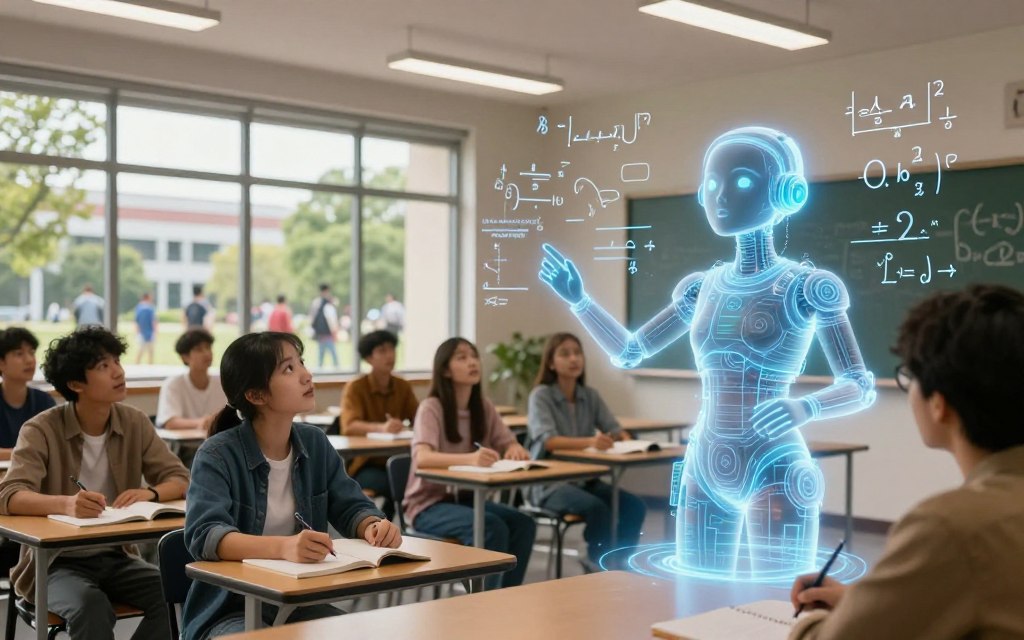

The way we learn is changing. Tools like ChatGPT and Google Gemini are now common in classrooms worldwide.
For students, these platforms are often the first place to turn when they struggle. The relief of getting instant, detailed help is a game-changer in generative AI in education.
This change raises important questions. Is AI just a smart calculator, or is it changing education for good?
Schools are looking into this. They’re using tools like Sowiso’s Solution Bot to teach in new ways.
But there’s also concern. Teachers are carefully thinking about AI’s role in learning. Their views are key to making sure AI is used wisely.
This article will dive into AI’s role as a learning tool. We’ll look at its uses, its limits, and what it means for education’s future.
The Rise of AI Tutors in the Digital Classroom
Educational technology has changed a lot. It’s not just about smarter software anymore. Now, we have interactive tools that help us learn through talking.
From Simple Calculators to Conversational Agents
Old digital tools were one-way. Sites like Khan Academy had great videos and practice problems. But, you could only get a yes or no answer, without a detailed explanation.
Now, with AI, things are different. Today’s tools use big language models to understand us. Ask a question, like “Why do we flip the inequality sign when multiplying by a negative?” and you get a detailed answer. This makes the software more like a Socratic tutor.
Defining the Modern Educational Chatbot
So, what makes a modern educational chatbot special? It’s an AI tool made for learning. It can understand and answer open-ended questions in a helpful way.
The big difference is that it explains things clearly and gives step-by-step solutions. It doesn’t just say `x = 5. It explains how to get there, checks if you understand, and can show you different ways to solve it.
Key Players: ChatGPT, Google Gemini, and Specialised Tools
The field has both all-around tools and ones that focus on specific areas. Knowing the difference helps pick the right tool for the job.
- General-Purpose LLMs (e.g., ChatGPT, Google Gemini): These are great at talking and understanding complex language. They can help with many subjects, including maths. But, they might give long or wrong answers sometimes.
- Domain-Specialised Maths Tools: These tools are made just for maths. They use special engines and knowledge bases to give accurate answers. For example, Sowiso’s Solution Bot helps with maths exercises by giving feedback right away.
It depends on what you need. If you want help with homework, a general LLM might be good. But, for precise maths, a special tool is better.
Can a Chatbot Solve Math Problems? Analysing Core Capabilities
Looking into AI’s math skills, we see it’s not just about yes or no answers. It’s about where it shines and where it falls short. Knowing this is key for anyone thinking about using AI in learning or work.
Arithmetic and Basic Computation: A Strong Foundation
AI chatbots are great at basic math. They add, subtract, multiply, and divide with almost perfect accuracy. This is because they’ve been trained on huge amounts of numbers and simple math rules.
They can handle fractions, percentages, and basic number theory easily. For students, they’re perfect for quick checks and practice. The strength here lies in pure pattern recognition, a task AI is very good at.
Algebraic Manipulation and Equation Solving
AI chatbots get a bit more complex when dealing with variables and equations. They can solve for unknowns, simplify expressions, and factor polynomials. They use rules to isolate variables and work on both sides of an equation.
This skill comes from natural language understanding and symbolic reasoning. But, they struggle with very complex systems or unusual notation. How well they do depends on seeing similar problems during training.
Calculus and Higher-Level Mathematics
Calculus is an exciting area for AI mathematical problem-solving. Chatbots can handle derivatives, integrals, and limits. They often give correct answers to standard questions.
Strengths in Step-by-Step Derivations
A big plus is AI’s ability to break down solutions into steps. For example, finding a derivative, it might list each rule applied. This is like a tutor explaining step by step.
Studies show students like this for checking their own work and understanding. This step-by-step explanation is a significant advantage for those struggling to follow a solution.
Limitations with Abstract Proofs and Novel Concepts
But, AI has big AI limitations in higher thinking. They struggle with creating solid mathematical proofs, which need creativity and deep understanding. They might come up with plausible but wrong justifications for theorems.
As Source 3 points out, teachers know AI fails with truly new problems that need creative thinking. Its thinking is based on past data, not new ideas. This is a big issue in advanced math.
| Mathematical Domain | AI Strength | Key Limitation | Primary Use Case |
|---|---|---|---|
| Arithmetic & Basic Computation | High-speed, high-accuracy calculation | Limited contextual understanding of word problems | Drills, instant answer verification |
| Algebraic Manipulation | Solving standard equations, expression simplification | Difficulty with atypical problem structures | Homework help, practising procedures |
| Calculus & Advanced Topics | Step-by-step derivation of standard problems | Poor performance on abstract proofs and novel concepts | Learning solution methodologies, checking work |
In summary, AI chatbots are impressive but limited in math. They excel in tasks that follow patterns but struggle with creativity and abstract thinking. Knowing their core capabilities and boundaries is the first step to using them wisely.
The Mechanics Behind the Maths: How AI Processes Problems
An AI solves math questions through advanced techniques. It breaks down problems into layers, turning words into logic. This complex process involves several systems working together.
Natural Language Processing (NLP) for Problem Interpretation
The first challenge is understanding the question. Natural language processing (NLP) helps here. It learns to grasp grammar, context, and intent in text.
For example, when a student asks, “If a train leaves Station A travelling at 60 mph…”, the chatbot sees numbers and logic. It doesn’t just read a story.
Parsing Word Problems into Mathematical Expressions
The NLP task is to parse the text. It extracts key parts and operations to form a math equation. For instance, it sees “60 mph” as a rate and “leaves Station A” as a start.
It then structures this data into an equation like distance = rate × time. Tools like SOWISO’s Solution Bot excel in this, linking casual language to strict syntax.
Leveraging Vast Training Datasets and Pattern Recognition
An AI’s math knowledge comes from vast datasets. These include textbooks, solved problems, and guides. By analysing these, the chatbot learns to solve problems based on patterns.
But, it may struggle with new or culturally specific problems. Its training data can introduce biases.
The Role of Symbolic Reasoning Engines
NLP handles language, but solving equations needs symbolic reasoning engines. These engines use logic and algebra to solve problems precisely. They work with symbols like ‘x’ or ‘y’ to simplify and solve equations.
Many chatbots use platforms like Wolfram Alpha, built on symbolic computation. This lets them provide not just answers but the steps to get there.
The table below contrasts the two primary technological approaches working together in a sophisticated maths AI:
| Technology | Primary Function | Strength | Typical Limitation |
|---|---|---|---|
| Natural Language Processing (NLP) | Interprets and parses human language into structured data. | Understands varied phrasing and contextual clues in word problems. | Can misinterpret ambiguous language or novel problem structures. |
| Symbolic Reasoning Engine | Executes mathematical operations based on formal rules and logic. | Delivers precise, step-by-step algebraic manipulation and verification. | Requires perfectly formatted input; cannot process raw, unstructured text alone. |
The best systems combine NLP and symbolic engines. NLP translates words into math, and the symbolic engine solves it. This way, the solution feels natural but is based on solid math.
Types of Mathematical Problems Suited for AI Assistance
Not all maths problems are the same when it comes to AI help. Some are much better suited than others. Knowing which ones are best helps students and teachers use chatbots wisely.
This is about using AI in a practical way. We want to make AI a trusted tool for teaching, not just a fun gadget.
Procedural Practice and Drills
AI is great at making lots of practice problems. This is perfect for getting better at basic skills.
Think of things like times tables, solving quadratics, or applying differentiation rules. These need lots of practice to get good at.
An AI tutor can make a never-ending worksheet just for you. It can also change the difficulty level as you go. This gives you the practice you need most. Studies show AI is changing how we learn basic skills.
Homework Help and Solution Checking
Students often use AI for homework help. It’s like having a study buddy all the time. But it does more than just give answers.
The key is solution checking. You try a problem on your own, then show your work to the AI.
The AI checks your steps and tells you if you’re right or not. This way, you learn more than just the final answer. It’s shown to help students understand better.
Tools like Solution Bot are made for this purpose. For more complex problems, checking out top AI math tools can help even more.

Conceptual Explanation and Alternative Methods
AI helps with understanding, not just solving. It can explain things in different ways.
If you don’t get something from a book, the AI can explain it differently. It might use an example or a different way of thinking.
AI also shows you different ways to solve problems. Seeing many ways to get to the same answer helps you understand the basics better.
This is key to competency-based education. It’s about learning to adapt and understand deeply, not just memorise.
The AI is like a patient teacher, always ready to explain. It helps you build a strong understanding of maths concepts.
| Problem Type | Best Suited For | Primary AI Benefit | Key Consideration |
|---|---|---|---|
| Procedural Practice | Building fluency in core skills (arithmetic, algebra steps) | Generates infinite, adaptive practice sets | Ensures variation to prevent rote memorisation without understanding |
| Homework Help | Verifying work, understanding mistakes, getting unstuck | Provides step-by-step verification and targeted feedback | Must be used to check logic, not just to retrieve answers |
| Conceptual Explanation | Grasping underlying theories and multiple solution methods | Offers tailored explanations and alternative perspectives | Supports the goals of competency-based education by fostering deep understanding |
In summary, AI is most useful for structured practice, checking work, and explaining things in different ways. Using it for these tasks can really improve learning maths.
Pedagogical Shifts: AI’s Impact on Teaching and Learning Maths
AI in maths is not just about giving answers. It’s about creating a deeper learning experience. This change turns AI from a simple tool to a key player in education. It changes how students learn and how teachers teach.
Studies show this big change. They focus on how AI helps students learn better and how teachers guide them. The goal is to use AI to help students understand, not just solve problems.
Moving from Answer-Fetcher to Socratic Tutor
The biggest change is how AI is used. Instead of just giving answers, advanced systems act as a Socratic tutor. They ask questions, not give answers.
This method helps students discover things for themselves. It builds their critical thinking and helps them remember things better.
Promoting Metacognition and Problem-Solving Strategies
This way of learning encourages students to think about their own thinking. They learn to analyse their problem-solving. They see what works and where they get stuck.
AI helps by asking the right questions. For example:
- “What is the first step you would take here?”
- “Why did you choose that method?”
- “Can you think of another way to approach this?”
This makes students feel more in control. They go from being passive to active learners.
Redefining the Teacher’s Role in an AI-Augmented Classroom
With AI handling routine tasks, teachers’ roles change a lot. They become more than just teachers. They help students use technology and guide them.
This change is shown in the table below:
| Aspect | Traditional Classroom | AI-Augmented Classroom |
|---|---|---|
| Primary Role | Sole knowledge deliverer and grader | Learning facilitator and tech-integration guide |
| Student Interaction | Often whole-class, limited individual time | More one-on-one mentoring, addressing complex needs |
| Feedback Timing | Delayed, after assignment submission | Supplied by AI in real-time; teacher adds depth |
| Resource Focus | Creating uniform materials for all | Curating personalised pathways and project-based learning |
Teachers can now focus on students who need extra help. They create more engaging activities. The AI handles the basics, freeing teachers for more important tasks.
Addressing Maths Anxiety Through Private, Patient Practice
AI can also help reduce maths anxiety. Many students are scared to make mistakes in front of others. This fear stops them from learning.
An AI Socratic tutor offers a safe space for practice. It doesn’t get frustrated or impatient. Students can try problems over and over without feeling embarrassed.
This safe space encourages students to take risks and learn from mistakes. As they become more confident, their motivation and engagement grow. This creates a positive cycle.
In the end, these changes help students a lot. They reduce maths anxiety and increase student agency. Students become more confident and independent in maths, thanks to AI and a skilled teacher.
Personalised Learning Pathways Powered by AI
Artificial intelligence is changing how we learn. It creates learning paths that fit each student perfectly. This means everyone gets the right help, making learning more effective and accessible.
Adaptive Difficulty and Tailored Problem Sets
AI adjusts the difficulty of questions based on how well you do. It’s not like a book that stays the same. The AI changes the questions to match your level.
If you’re good at basic algebra, it can make things harder. If you’re struggling, it makes things easier. This way, you learn at your own pace, not just because of time.
Identifying Knowledge Gaps with Diagnostic Analysis
Modern chatbots do more than just check answers. They look closely at mistakes. For example, a wrong answer in algebra might show a problem with understanding, not just a simple mistake.
They can find out exactly where you’re going wrong. This helps teachers focus on what you really need to work on. It’s like having a personal tutor that knows exactly what you need.
Providing Instant, Formative Feedback
Getting feedback right away is very important. It helps you learn as you go, not just at the end. AI gives feedback quickly, helping you fix mistakes right away.
This feedback loop is powerful. It helps you learn faster and avoid making the same mistakes over and over. It makes learning more active and effective.
AI makes learning better by adjusting the difficulty, finding out where you need help, and giving feedback right away. This way, learning is always relevant and tailored to you.
Practical Integration: Using Chatbots in Maths Education Today
AI tutors are becoming essential, not just a novelty. We need clear steps for using them in blended learning. This section will guide students and teachers on how to use chatbots effectively.
Best Practices for Students Seeking Homework Help
For learners, an AI chatbot is a powerful tool. It’s not just about getting the right answer. It’s about understanding maths concepts better.
Start by asking specific questions. Instead of “solve this equation,” ask “Can you explain how to solve 3x + 7 = 16?” This helps the AI guide you, not just give answers.
Using AI to Understand Mistakes, Not Just Get Answers
When you get an answer wrong, use AI to find the mistake. Ask, “Where did I go wrong in step two?” This helps spot common mistakes in maths.
Don’t rely too much on the chatbot. Use it to check your work after trying it yourself. This builds your skills and ensures the AI helps, not hinders, your learning.
Lesson Planning and Resource Creation for Educators
Teachers can use AI chatbots to make lesson planning easier. They can generate practice problems and worksheets, reducing teacher workload.
Teachers can ask the chatbot to create specific questions. For example, “Make five word problems on quadratic equations for Year 10.” This helps identify areas where students need more help.
This technology makes classrooms more dynamic. Teachers can focus on helping students one-on-one, not just teaching.
Case Study: Implementation in Secondary School Curricula
A pilot at Radboud University used Sowiso AI tutors. They blended online practice with traditional teaching in maths.
At first, students were hesitant. But with training, they got better. Teachers found they could use their time more efficiently.
In another school, teachers used chatbot data to adjust lessons. This reduced their workload. The key was to see the AI as a tool, not a replacement.
Critical Shortcomings and Current Limitations
Before we fully embrace AI maths assistants, we must look at their weaknesses. They often give confident but wrong answers. These tools are powerful aids, but not perfect.
Their flaws include technical issues and gaps in reasoning. These challenges are similar to those faced by humans in surprising ways.
Hallucinations and Incorrect Solutions
One major flaw is AI hallucinations. The chatbot gives a solution that looks right but is actually wrong. This is not just a simple mistake.
It often involves misused rules or made-up steps. For students, this is very dangerous. It can make them believe in wrong answers.
It’s important to check answers, not just trust the AI. When you compare top AI chatbots, you’ll see they all have these errors.
The “Black Box” Problem: Lack of Explainable Reasoning
Even when an AI gives the right answer, it’s hard to understand how. This “black box” issue means the chatbot can’t explain its reasoning. It shows the steps, but not why.
This is a problem for maths teaching. We learn by understanding the “why.” An AI that can’t explain its steps holds back learning.
Struggles with Genuine Creativity and Unstructured Problems
AI is great at finding patterns in its training data. But it struggles with new, open-ended maths problems. It can’t think outside the box.
AI uses known methods. It can’t come up with new ones. This limits its use in advanced maths and research.
When Intuition and Insight Trump Computation
Some maths breakthroughs come from sudden insights. Humans can see patterns or connections that AI misses. AI lacks this critical thinking and intuition.
AI can’t have a “eureka” moment. This shows a big difference between AI and human maths abilities.
Dependence on Data Quality and Possible Biases
An AI’s knowledge is only as good as its training data. If the data has errors or biases, so will the AI’s answers. For example, an AI trained on one type of maths might not know others.
This makes us worry about AI tutors being fair for all students. We need to make sure the training data is diverse and accurate.
| Limitation Type | Primary Risk to Learning | Recommended Mitigation |
|---|---|---|
| Hallucinations & Incorrect Answers | Reinforcement of misconceptions, erosion of trust. | Always verify solutions with a second source or teacher. Use AI for idea generation, not final answers. |
| Black Box Reasoning | Superficial learning, lack of conceptual understanding. | Ask the AI to explain each step in simple terms. Pair AI use with “explain in your own words” exercises. |
| Lack of Creative Problem-Solving | Over-reliance on procedural thinking, inability to tackle novel challenges. | Reserve unstructured problems for human collaboration and discussion. Use AI for practice, not for innovation. |
| Data Bias & Gaps | Skewed or incomplete knowledge, inequitable support. | Use AI tools from reputable providers with transparent training data policies. Cross-reference multiple educational resources. |
Knowing these weaknesses doesn’t mean we should give up on AI tutors. It means we should use them wisely. By questioning AI’s answers, we can learn more. This makes learning stronger and more critical.
Ethical Considerations and Academic Integrity
AI tutors raise big questions about academic integrity and student care. Using these tools in schools is more than just a tech update. It needs a strong ethical AI framework. This framework should help use AI wisely, keep students safe, and make learning better.
Navigating the Line Between Assistance and Cheating
Teachers worry about when help turns into cheating. It’s all about the student’s intent and how they use the tool.
Helping with a math problem is okay, but using a chatbot to do all the work is not. Teachers need to teach students how to use AI wisely. It should help them learn, not just give answers.
Schools need to update their rules to fit this new way of learning. This means teaching students to use AI in a way that keeps learning honest.
Developing New Assessment Models for the AI Age
AI can give answers, so old tests don’t work anymore. We need new ways to check if students really get it. This means looking at how they learn, not just what they know.
New tests might include talking about what you’ve learned or showing how you solved a problem. The focus is on the journey, not just the end result.
| Traditional Assessment Model | AI-Age Assessment Model | Core Skill Evaluated |
|---|---|---|
| Closed-book final exam | Open-resource case study analysis | Information synthesis & critical evaluation |
| Graded homework for correct answers | Portfolio documenting problem-solving process | Metacognition & iterative improvement |
| Standardised multiple-choice test | Student-led explanation of an AI-generated solution | Communication & conceptual understanding |
Data Privacy and Student Information Security
Chatbots in schools handle personal info. Keeping this safe is key to ethical AI in education.
Good edtech follows strict security rules. Schools should choose tools that are open about how they use data and follow laws like FERPA.
Students and parents should know how their data is used. Trust comes from being open and keeping digital info safe.
Ensuring Equitable Access and Digital Divides
AI tutoring might not help everyone because of money issues. Not everyone has the tech or internet needed.
This could make some students get left behind. Schools, districts, and tool makers need to work together:
- Institutional Investment: Schools need to make sure everyone has the tech and internet they need.
- Tool Selection: Choose AI tools that are affordable or free.
- Pedagogical Focus: Make sure AI helps, not replaces, the teaching that all students need.
Without action, AI could make learning gaps wider. It’s important to make sure AI helps all students, not just some.
The Evolving Role of AI Tutors in Future Education
Future educational tools will do more than just answer questions. They will show how math problems are solved, making learning clearer. This change will affect how students learn and what skills are most important.
Towards Multimodal AI that “Shows Its Work” Visually
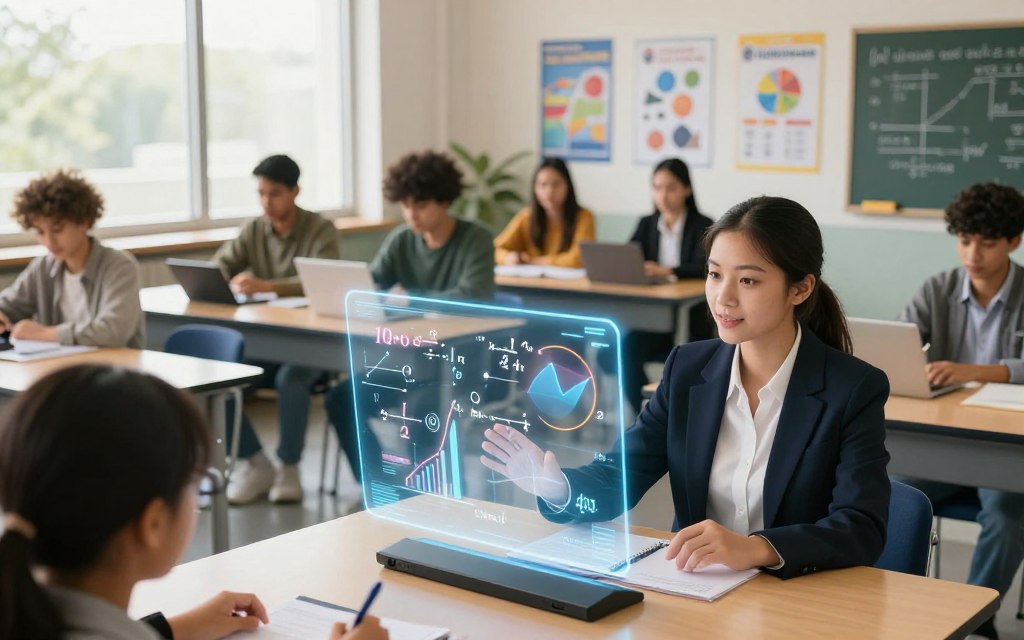
Current chatbots are limited because they don’t show their thought process. The next AI math tutors will be able to show their work in pictures and words.
Imagine an AI that solves equations and shows its steps in a neat, handwritten style. For subjects like geometry or calculus, it can create accurate graphs and diagrams instantly. This visual help is key to understanding, just like how teachers use whiteboards.
This change from just answering questions to showing how it’s done makes the AI’s logic clear. Students can learn by seeing the steps, not just the answer. This leads to a deeper understanding of the subject.
Integration with Formal Learning Management Systems
For the best results, these advanced tutors need to work with learning platforms. Systems like Canvas, Moodle, or Sowiso will likely include AI tutors. This makes learning more effective and connected.
This setup creates a powerful loop. Teachers can set homework through the LMS. The AI helps students as they work. Then, the teacher gets feedback on how well the students are doing.
The benefits are clear:
- Streamlined Workflow: Students get help right where they learn, without switching apps.
- Data-Informed Teaching: Teachers get detailed data to improve their teaching and help students better.
- Personalised Pathways: The AI can adjust homework based on how well students are doing, making learning more tailored.
Preparing Students for a World Co-inhabited with AI
These changes are not just about better homework help. They mark a bigger shift, influenced by the idea of Technological Determinism. This idea says technology shapes our society and how we behave.
Education needs to prepare students for a world where working with AI is normal. The focus moves from just teaching math to teaching how to use AI wisely and ethically.
Future literacy will include knowing how to question AI, understand its limits, and use it for creative problem-solving.
This means teaching students the basics, then using AI to explore and verify. Teachers will guide this process, making sure students keep their human skills sharp.
In the end, the AI math tutor helps us prepare a generation that is empowered by technology, not replaced by it.
Conclusion
Can a chatbot solve math problems? The answer is yes. Modern AI is very good at solving math, from simple to complex problems. It makes learning more personal and scalable.
Students get instant feedback and practice that fits their needs. This makes learning more effective.
But, chatbots are not perfect. They can make mistakes or not explain their answers well. Teachers are key for helping students understand and think critically.
Teachers should not be replaced by AI. Instead, AI should help teachers do their jobs better.
AI can handle routine tasks like grading, freeing up teachers to focus on important work. They can have deep conversations and mentor students one-on-one. This makes learning more meaningful.
The future of education is about working together. AI helps with the basics, while teachers focus on what matters most. This way, technology improves learning without replacing human connection.
FAQ
Can AI chatbots like ChatGPT and Google Gemini actually solve complex maths problems?
Yes, AI chatbots can solve many maths problems. They handle simple to complex tasks. But, they struggle with very new or abstract problems.
How does an AI chatbot understand and solve a worded maths problem?
Chatbots use Natural Language Processing (NLP) to understand maths problems. They turn the problem into a format they can solve. This skill comes from training on lots of examples.
What types of maths problems are best suited for AI assistance?
AI is great for procedural practice and drills. It’s a good homework companion for checking work. It also helps explain concepts in different ways.
How can using an AI chatbot for maths help reduce anxiety?
AI offers a safe space for practice. Students can ask questions without fear. This builds confidence and reduces stress.
How does AI enable personalised learning in mathematics?
AI adjusts problem difficulty based on how well you do. It helps identify and fix knowledge gaps. Tools like Sowiso’s Solution Bot give instant feedback.
What are the best practices for students using AI for maths homework?
Use AI as a tutor, not just for answers. Ask for explanations and use it to understand mistakes. Don’t rely too much on AI.
What is a “hallucination” in the context of AI maths solvers?
A hallucination is when AI gives a wrong but sounding right answer. This is a big problem. Always check AI answers yourself.
How can educators prevent students from using AI to cheat?
Change how you test students. Focus on the process and understanding, not just answers. Use different types of tests and explain the ethics of AI use.
What does the future hold for AI tutors in maths education?
Future AI tutors will be more advanced. They’ll create visual solutions and work better with learning systems. The goal is to teach students to use AI wisely.


 By
By