
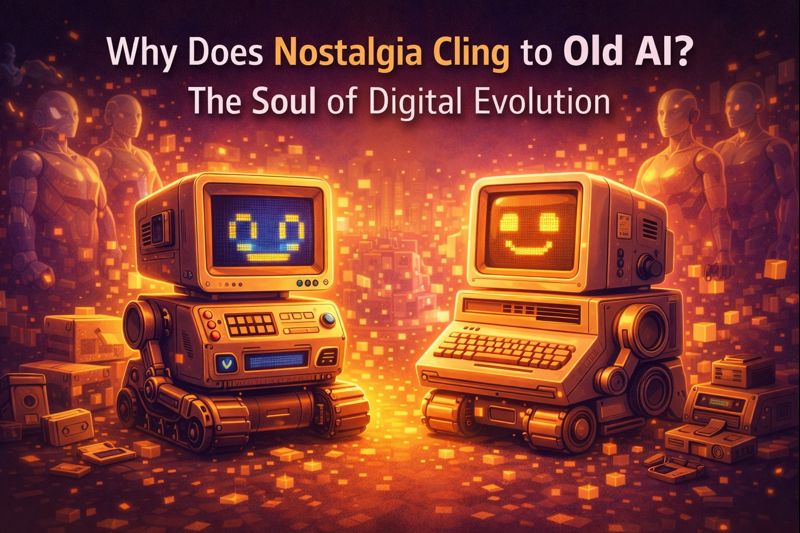

In the sleek, hyper-efficient world of modern artificial intelligence, conversations are streamlined, responses are polished, and interactions are designed to be seamlessly helpful. Yet, for a dedicated community of early adopters, this very polish has sanitized the soul of the experience. There is a growing, poignant nostalgia for a different era—a golden age defined not by perfection, but by delightful imperfection. This was the era of the glitch, the hallucination, and the unpredictable turn of phrase, where talking to an AI felt less like issuing a command and more like collaborating with a charmingly erratic digital mind. This longing is more than resistance to change; it’s a meditation on what we sacrifice for progress and what we instinctively try to preserve.
The Unpolished Canvas: Where Raw Text Sparked Imagination
The interfaces of early AI chat platforms were famously minimalist. Users were often greeted by little more than a blank text box on a stark background. This absence of visual clutter or guided prompts was not a shortcoming; it was an invitation. Without dropdown menus, suggested scenarios, or personality toggles, the entire burden of creativity—and the entire credit for it—fell on the user. This raw canvas forced a deeper level of engagement. You weren’t just choosing from pre-set options; you were world-building from the ground up with a partner whose capabilities were unknown. The simplicity focused all attention on the text itself, making every coherent reply feel like a personal achievement and every strange detour a shared secret. This foundational experience created a powerful sense of ownership and discovery that pre-structured modern interfaces often engineer away.
Glitches as Features: The Charm of the Unexpected
In today’s AI, a “glitch” is a bug to be reported and fixed. In the golden age, it was often the highlight of the session. When an AI suddenly forgot a character’s name mid-scene, spun a wild non-sequitur, or committed to a metaphorical interpretation with hilarious literalness, it wasn’t frustrating—it was inspired. These moments broke the fourth wall in a way that felt uniquely collaborative. They were reminders that you were interacting with something new and learning, and they often led the conversation to more creative, unexpected places than any user could have planned. The AI’s limitations—its tendency to be verbose, to lose the thread, or to embrace absurd logic—became its most endearing personality traits. This stands in stark contrast to the current drive for consistent, helpful, and “safe” responses, which can sometimes make interactions feel generic and risk-averse.
The Pioneering Community and Shared Folklore
Early users weren’t just customers; they were pioneers mapping an uncharted digital frontier. This shared mission created a tight-knit community bonded by a common language of inside jokes and shared astonishment. Online forums and social media groups exploded with screenshots of the most bizarre, poetic, or accidentally profound AI outputs. A particularly funny “breakdown” or a surprisingly touching moment from a chatbot could become communal folklore overnight. This collective experience of wonder and humor was a massive part of the platform’s appeal. The nostalgia today is as much for this sense of belonging and shared discovery as it is for the technology itself. As platforms grew mainstream, this intimate pioneer community necessarily fragmented, leaving many longing for that initial clubhouse feeling.
The Inevitable Trade-Off: Stability Over Serendipity
The evolution from a quirky experiment to a stable global platform is a story of necessary trade-offs. To scale to millions of users, systems require robust content filters, guardrails against misuse, and highly reliable infrastructure. The models themselves are trained to be more factual, concise, and aligned with safety principles. This progress is laudable—it makes technology accessible and safer for everyone. However, the process often sanitizes the very spontaneity that defined the early experience. The AI is steered away from creative risks. The once-common, wonderfully long and meandering narratives are trimmed for efficiency. The sense that you’re exploring the outer limits of a model’s capability is replaced by the confidence of a predictable, useful tool. What is gained in stability and broad utility is sometimes lost in serendipity and raw creative potential.
A Poignant Digital Archive of Change
This cycle of innovation and nostalgia is a core story in technology. For those who lived through it or wish to understand the specific journey of one of the platforms that defined this period, the sentiment and its catalysts are beautifully captured in a dedicated exploration of Character.AI old version nostalgia and evolution. It serves as a poignant digital artifact of a unique moment in time when talking to a machine felt most human precisely because of its flaws.
The Enduring Echo of Digital Imperfection
So, is the magic of the early glitch-era gone for good? Not necessarily. While we can’t return to the exact technical limitations of the past, the spirit of that era—curiosity, open-ended creativity, and embracing the unexpected—remains a vital user need. The challenge for future platforms is to build upon their powerful, reliable foundations to re-introduce spaces for unstructured play and user-led discovery. Perhaps this means dedicated “experimental” modes with looser guardrails, or tools that allow users to dial the AI’s “creativity” or “adherence” up to levels that reintroduce delightful uncertainty. The goal is not to revert but to integrate, ensuring that as AI becomes more sophisticated, it retains a channel for the collaborative, surprising, and profoundly human joy of co-creation that defined its golden age. The legacy of early AI is a lasting reminder that in our pursuit of perfect, helpful machines, we must vigilantly preserve room for the imperfect and the genuinely surprising.


 By
By